Career coaching and life coaching are priced the same.
15+years in the workforce
9+years managing and leading teams
2coaching tracks: career and life
About
Coaching built on real experience
I'm Basma, a Business Development Manager with more than 15 years in the workforce. For over 9 of those years I've managed teams and helped the people on them grow.
Along the way I met many talented people who felt stuck, and many who wanted change but didn't know where to start. That's why I coach. I offer career coaching and life coaching sessions, write books, and share content online about work, life, and how to live better.
15+ years
In the workforce
Hands-on experience across different teams, markets, and challenges.
9+ years
Leading teams
Managing people, developing talent, and building healthy team cultures.
Business Development
Growing businesses
Building relationships, opening opportunities, and turning goals into results.
Coaching, books & content
Sharing what I've learned
Through one-to-one sessions, my books, and everyday content online.
A book about the scars life leaves behind, each with its own story. Not a magic cure, but a companion that reminds you you're not alone, and that what you've survived made you stronger.
Many women who step away from work to raise children tell me the same thing when they think about returning: "I don't know if I can still do it." The skills are usually still there. What has faded is the belief in them.
Coming back after a year, five years, or more is a real transition, and it deserves a plan. Here is the approach I share with the women I coach.
1. Rewrite the story you tell about the gap
A career break is not an empty space. You managed schedules, budgets, priorities, crises, and people who do not negotiate politely. You learned patience and how to make decisions with very little sleep. When you describe your break, say it plainly and with confidence: "I took time to care for my family, and now I'm ready to bring my experience back to work." No apology needed.
2. Update before you apply
Spend a few weeks catching up before you start sending your CV. Read about how your field has changed, take a short online course in the tools people use now, and reconnect with two or three former colleagues. A coffee or a phone call often teaches you more about today's market than any job board.
3. Decide what "work" means for you now
Your life has changed, so your career can change too. Ask yourself what you actually need: full time or part time, in the office or remote, the same field or a new one. Be clear about your non-negotiables, such as school pickup or a day each week at home, before an employer asks.
4. Plan the home side, not just the job side
Most returns struggle at home, not at the office. Talk with your partner and family about who will do what. Arrange childcare early and have a backup for sick days. Lower the bar on things that do not matter. A perfect house is not the goal; a calm family is.
5. Give yourself a real adjustment period
The first three months will feel heavy. You will be tired, and you might feel guilty on both sides: at work for thinking about home, and at home for thinking about work. That is normal. It does not mean you made the wrong choice. Measure yourself after six months, not after six days.
A final word
You did not lose yourself while you were at home. You grew in ways a job description cannot capture. Going back is not starting from zero. It is starting from everything you have become.
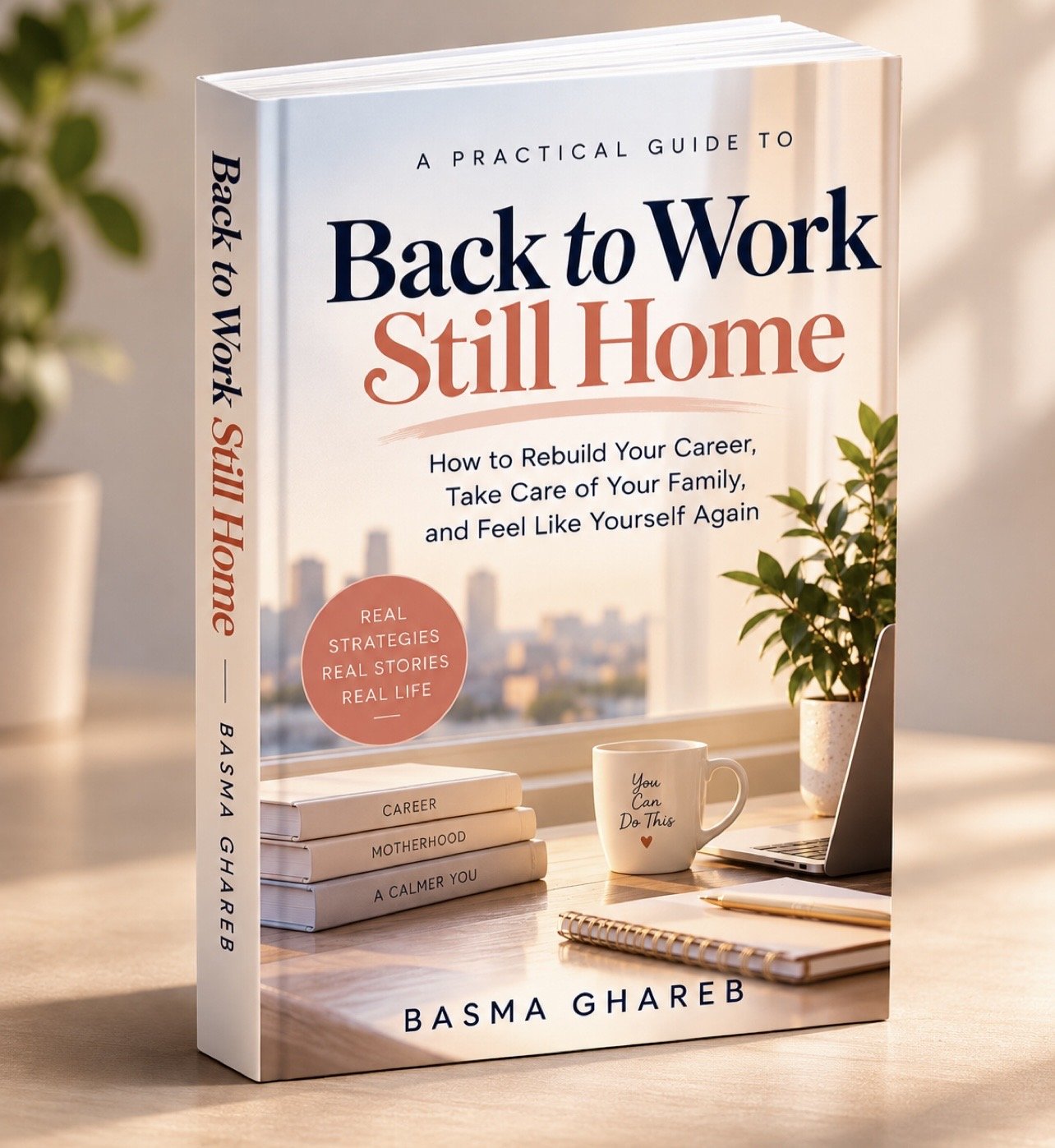
I wrote about this in much more depth in my book Back to Work, Still Home, with real stories and practical tools for the transition.
Leadership · 6 min read
Your first 90 days as a new manager
By Basma Ghareb
Most people get promoted to manager because they were great at their job. Then, on day one, they discover that the job has completely changed. Your success is no longer about what you do. It is about what your team does.
After more than nine years of leading teams, these are the lessons I wish someone had told me at the start.
Weeks 1 to 4: listen more than you talk
Resist the urge to change things right away. Book a one-to-one with every person on your team and ask simple questions. What do you enjoy about your work? What gets in your way? What should I know that nobody will tell me? Take notes. People remember the manager who listened before acting.
Weeks 5 to 8: set clear expectations
Unclear expectations cause most team problems. Agree with each person on what good work looks like, how you will communicate, and how often you will meet. Write it down. Then hold yourself to the same standards you set for them.
Weeks 9 to 12: start one small improvement
By now you know where the real friction is. Pick one thing to fix, ideally something your team raised in those early conversations. A small visible win builds more trust than a big restructuring plan.
Three mistakes to avoid
Doing the work yourself. It feels faster, but it teaches your team that you do not trust them and it burns you out.
Trying to stay "one of the team." You can be warm and close to people, but you are now responsible for decisions that affect them. Be friendly, and be fair.
Avoiding hard conversations. Feedback delayed is feedback that grows. Say it early, kindly, and in private.
Look after yourself too
Being a new manager can be lonely. Find a mentor, a peer manager, or a coach you can think out loud with. Leading others starts with leading yourself, and that is much easier when you have support.
Career growth · 5 min read
Is it time to change your job?
By Basma Ghareb
Almost everyone has a Sunday night when they dread going back to work. One bad week does not mean you are in the wrong job. A bad year might. The hard part is telling the difference.
Before you make a big decision, sit down with a notebook and answer these five questions honestly.
1. Is it the job, the manager, or the season?
Some frustration comes from a difficult project, a tough quarter, or one difficult person. Those things pass or can be changed. If you can imagine enjoying the same role with a different manager or team, a move inside your company might be enough.
2. Am I still learning?
When you stop learning, you stop growing, and boredom slowly turns into frustration. Ask yourself what new skill you gained in the last six months. If the answer is "nothing," talk to your manager about new responsibilities before you look elsewhere.
3. How does this job affect the rest of my life?
Notice your sleep, your health, your patience with your family, and your weekends. A job is allowed to be demanding. It is not allowed to take everything. If the cost is showing up at home, take it seriously.
4. Am I running away, or moving toward something?
"Anything but this" is a weak reason to choose your next step. Try to describe what you want instead: the kind of work, the people, the pace, the pay. The clearer the picture, the better your next choice will be.
5. What is my plan if I leave?
Changing jobs should be brave, not reckless. Check your savings, update your CV and LinkedIn profile, and start conversations with people in the field you are interested in before you hand in your resignation.
What your answers tell you
If most of your answers point to something temporary, focus on changing your situation where you are. If they point to a lasting mismatch, it is probably time to plan a move. Either way, you are making a decision, not just reacting to a bad day.
If you want help working through these questions, that is exactly what we do together in a career coaching session.